Madrid Marathon 2026: What Makes the Difference in the Final Weeks
The 48th edition of the Madrid Marathon takes place on Sunday, April 26, 2026. With four weeks to go, the question isn't whether you've trained enough — that answer can't be changed now. The question is whether you're going to manage what's left correctly.
You're not going to get fitter between now and race day. The training is done. What you can do — and what genuinely separates a race that feels right from one that falls apart at km 35 — is execute the tapering, carb loading and race day strategy correctly.
The science is clear: a runner who progressively reduces volume over 3 weeks arrives at the start line with 13-34% more muscle glycogen. A 2021 study published in Frontiers in Sports and Active Living tracking 141 marathon runners found that those who followed a disciplined taper finished, on average, 5.5 minutes faster than those who barely reduced training in the final week.
Five and a half minutes. No extra training.
Week-by-Week Plan: The Final 4 Weeks of Marathon Preparation
Week 1: The Last Training Block
This is the last week where adding meaningful training load makes sense. If you have a long run of 28-30 km still scheduled, this is when to do it — not next week.
Do:
- Complete your final long run if it's still in the plan
- Finish any quality sessions you have scheduled
- Prioritize sleep and recovery from Wednesday onward
Avoid:
- Compensatory mileage ("I didn't run enough this month, I'll make up for it")
- Heavy lower-body strength training
- Unplanned impact activities: hiking, football, padel
Week 2: Tapering Begins
This is where the real reduction starts. Evidence-based guidelines recommend cutting volume by 40-60% from your peak week, while maintaining intensity. The most common mistake: running slower instead of running less.
You're going to feel strange. Unexplained fatigue, heavy legs, doubts about your fitness. This is taper madness — a normal physiological response when you reduce load after months of training. Don't mistake it for being in poor shape — it's the signal that your body is absorbing the work.
Do:
- Cut weekly volume by around 40-50%
- Keep one or two workouts at marathon goal pace
- Start reviewing logistics: bib pickup, transport, accommodation if needed
Week 3: Low Volume, High Quality
Second taper week. Volume drops another step. Workouts are short but you maintain some stimulus at goal pace to remind your body what speed it's going to race at.
This is also the week to lock in every detail:
- Do you have your bib pickup date confirmed?
- Do you know how to get to the start area on Paseo de la Castellana?
- Have you tested your race-day nutrition — gels, isotonic drinks, bars?
Golden rule: nothing new on race day. If you haven't tested it in training, don't use it in the marathon. GI issues are the most common cause of DNFs.
Week 4 — Race Week: Race Mode
The final ten days are critical for carbohydrate loading and mental management.
What to Eat Race Week at the Madrid Marathon
Start carb loading 5-6 days before the race. The goal is to saturate muscle glycogen stores. The evidence-backed recommendation: 10-12 grams of carbohydrates per kg of body weight per day for the 2-3 days leading up to the race.
For a 70 kg runner, that's 700-840g of carbs daily. Spread it across 5-6 meals throughout the day, not in one large sitting.
Best foods: rice, pasta, white bread, potato, banana, oats. Reduce fiber — race day is not the time to experiment with your digestive system.
What not to change:
- Saturday dinner doesn't need to be a pasta feast. Eat what you normally eat, slightly more carbs.
- Sunday breakfast: exactly what you've eaten before your long training runs. Early — 2-3 hours before the gun.
Madrid Marathon 2026: Logistics and Race Day Strategy
Start, Course and Aid Stations
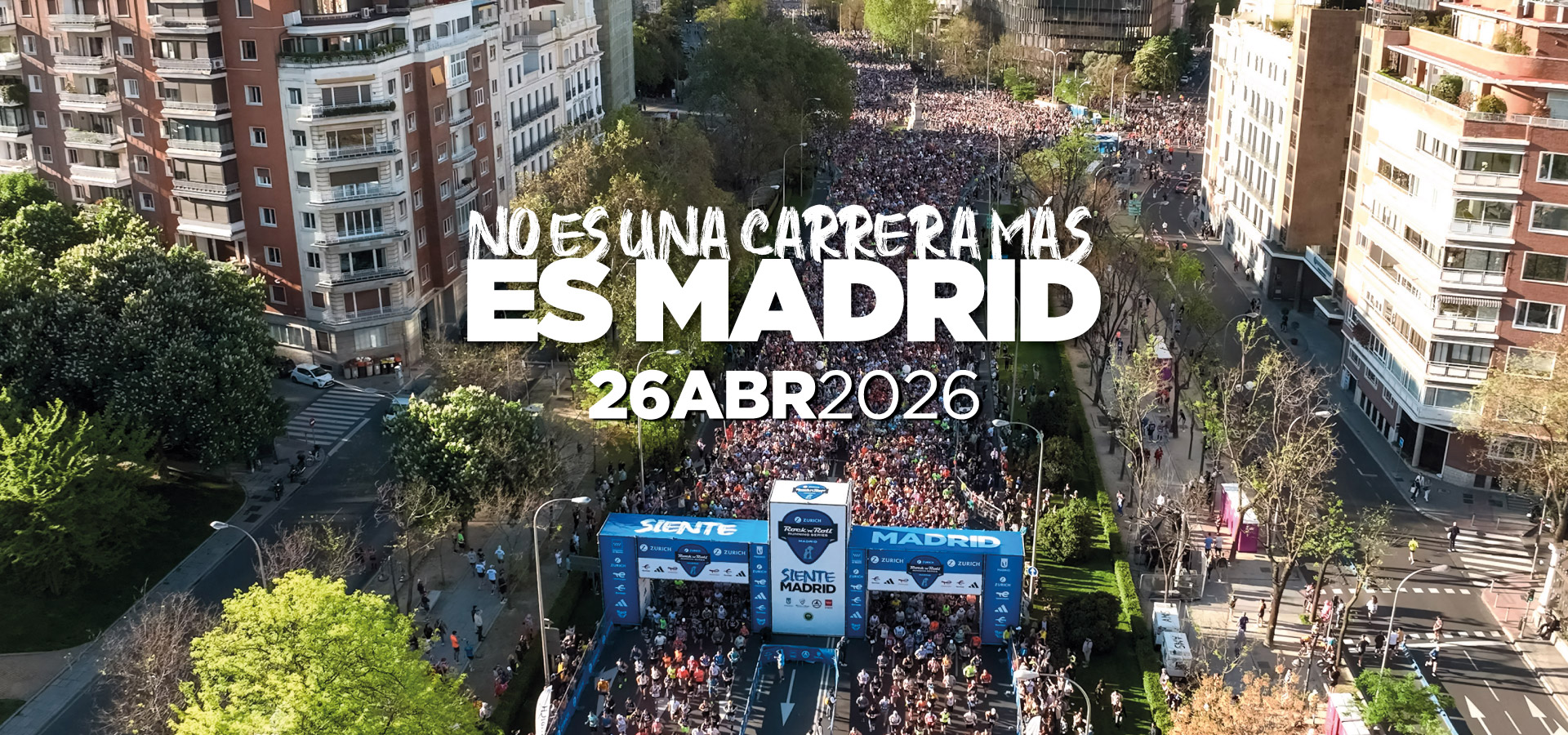
The 2026 Madrid Marathon starts at Paseo de la Castellana at 9:00 AM and finishes at Paseo de Recoletos. There are water and isotonic stations approximately every 5 km. If you're not used to drinking on the run, practice before race day — stopping completely at aid stations costs time and breaks your rhythm.
Pace Strategy: The First 10 km Are Everything
The atmosphere and adrenaline will make the first few kilometers feel effortless. That's a trap. The first 10 km should be at or slightly slower than your target pace. Every extra second you spend early costs three times as much in the final stretch. Negative splits aren't a theoretical ideal — they're the strategy that actually works in marathon running.
The Wall at km 30-35
If you're going to hit the wall, it usually happens between km 30 and 35. The primary cause is muscle glycogen depletion. A well-executed taper and carb load significantly reduce that risk — but don't eliminate it entirely. Take gels or carbohydrates from km 20 onward; don't wait until you feel empty.
One Race, 45,000 Stories
The 2025 edition set an all-time participation record: 45,000 runners across all distances, with 13,000 in the marathon. The course records stand at 2:08:18 for men (Reuben Kerio, 2019) and 2:26:24 for women (Shasho Insermu, 2019).
Manage the taper, load your carbohydrates properly, respect the start — and let your training do the work on April 26.
Sources
- Vesterinen, V. et al. (2021). Longer and More Disciplined Tapers Improve Marathon Performance. Frontiers in Sports and Active Living. pmc.ncbi.nlm.nih.gov/articles/PMC8506252
- PMC/NIH (2023). Effects of Tapering on Performance — Systematic Review. pmc.ncbi.nlm.nih.gov/articles/PMC10171681
- Precision Hydration (2024). How to Carb Load Before a Race. precisionhydration.com
- Rock 'n' Roll Running Series Madrid (2026). Event Information — 48th Madrid Marathon. rocknrollmadridrun.com
- La Bolsa del Corredor (2025). Maratón de Madrid 2025 — All-time participation record: 45,000 runners.